
SEO & Google optimization
We help you show up better in Google through technical optimization, clearer content and better website structure. The work can be done as a one-off effort or as ongoing optimization depending on goals, competition and budget.
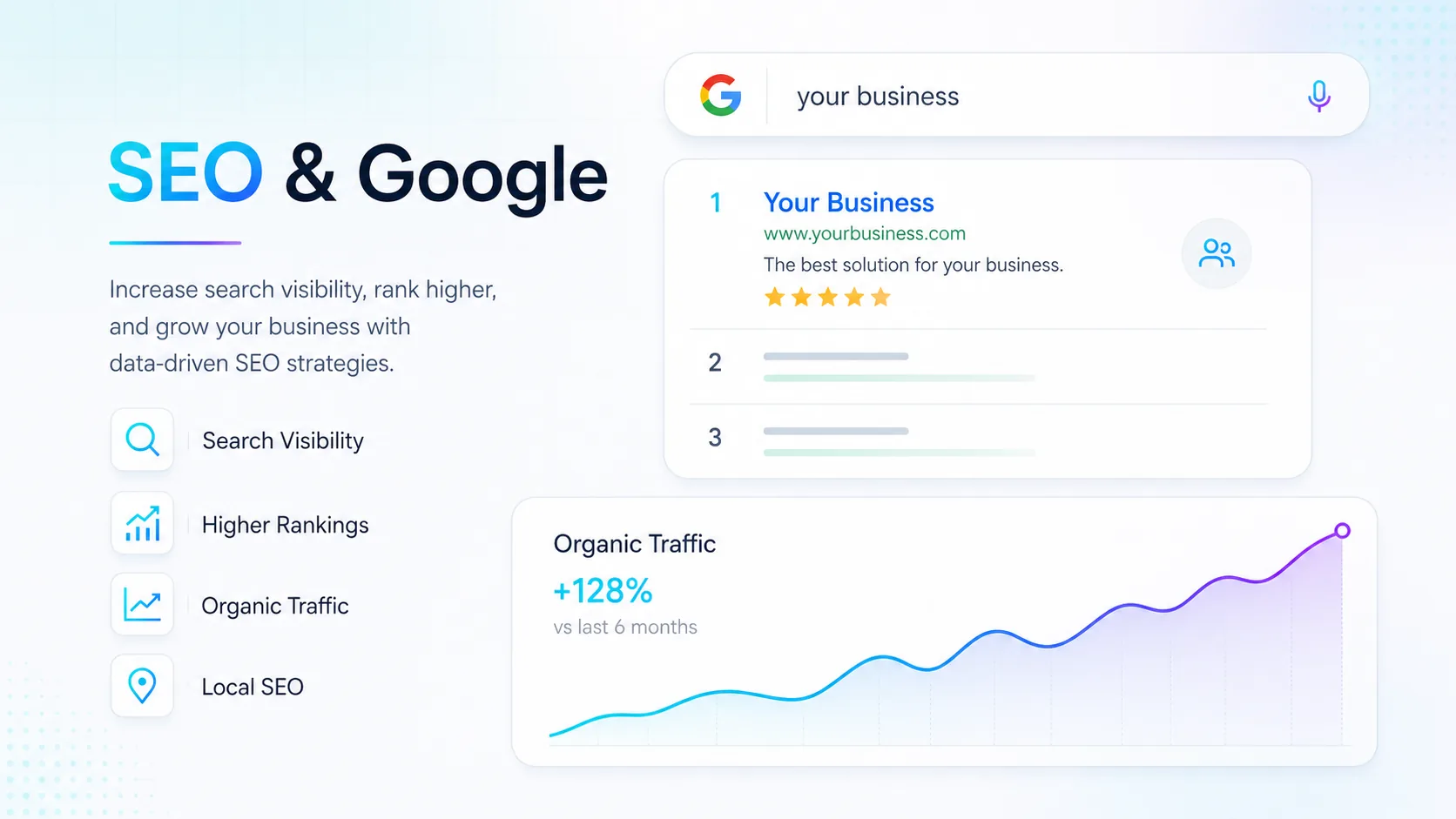
What we help you with
We help you show up better in Google through technical optimization, clearer content and better website structure. The work can be done as a one-off effort or as ongoing optimization depending on goals, competition and budget.
When this service fits
A good fit if you want to rank higher in Google, be visible locally, or get more qualified traffic to your website over time.
What can be included
- Keyword research based on real search intent
- Technical audit: speed, structure, indexing
- Content that answers your customers' questions
- Measurable reporting every month
Packages & starting prices
Starting prices give a clear baseline for different types of work. Smaller jobs can often start quickly, while larger projects begin with a short review or pre-study. After the review you get a clear proposal with scope, price and next step.
| Package | Best for | Starting Price |
|---|---|---|
| Basic SEO for new websites | Page titles, meta descriptions, structure, mobile and technical base | Included |
| SEO review of existing website | Review of titles, headings, speed, indexing and structure | from $150 |
| Google Business Profile | Create or optimize a Google Business Profile | from $150 |
| Technical SEO fix | Fix technical issues affecting visibility and indexing | from $290 |
| Ongoing SEO Starter | Lighter ongoing optimization, tracking and reporting | from $99/month |
| Local SEO | Local visibility and 'near me' searches | from $199/month |
| SEO Growth | Keywords, content improvements and follow-up | from $299/month |
| SEO Plus / competitive SEO | Technical, content, links and strategy in tough competition | Custom quote |
All prices are starting prices in USD. Hosting, domains, licenses, third-party tools, advertising budget, AI usage and external platform fees are not included unless stated in the proposal. Final pricing depends on scope, integrations, content and support level.
Frequently asked questions
SEO, or search engine optimization, is about improving a website so Google and other search engines can better understand the content. It is also about making the website more relevant, clear and useful for the people searching for your services.
The work can include technical improvements, structure, content, keyword research, local visibility and ongoing follow-up.
SEO is suitable for companies that want more visibility in Google over time and more qualified traffic to their website. It is especially relevant if customers often search for your services, products or solutions before contacting you.
SEO also suits companies that want to be visible locally, build long-term presence and reduce dependence on paid advertising.
SEO is about organic visibility in search results and is built over time. Google Ads is paid advertising where you can appear faster, but traffic usually stops when the ads are paused.
Both can work well together. SEO builds long-term visibility, while advertising can provide faster testing, traffic and campaign results.
Google Business Start includes setting up or optimizing the company’s Google Business Profile. This can include business information, category, description, opening hours, images, services, contact details and basic structure.
The service is suitable for companies that want to improve local visibility in Google Search and Google Maps.
The Google Business Profile is often the first thing local customers see when searching for a company, service or place. A clear and updated profile makes it easier for customers to find address, phone number, opening hours, reviews, images and links.
For local businesses, this is an important part of their digital presence.
SEO Start is a basic SEO effort where we review keywords, site structure and prioritized improvements. It can include suggestions for which pages are needed, which searches to focus on and which technical or content-related issues should be handled first.
It suits companies that want to get started with SEO without immediately committing to a larger ongoing plan.
Keyword research is about understanding what potential customers actually search for. It is not only about individual words, but also search intent: whether the person wants to buy, compare, find a local supplier, read information or solve a specific problem.
Good keyword research helps you create the right pages, the right content and a clearer structure.
Search intent means what the person actually wants to achieve with their search. Two people can use similar keywords but have completely different needs. One may want to compare suppliers, another wants to book directly and a third only wants to understand a topic.
SEO works better when the content matches the search intent, not only the keyword itself.
A technical SEO audit is a review of technical factors that can affect how the website performs in search results. This can include loading speed, indexing, site structure, internal links, broken links, mobile friendliness, metadata, sitemap, robots.txt, duplicate content and technical errors.
After the review, you get a clearer picture of what should be fixed and in what order.
A technical SEO audit is suitable when the website has lost traffic, loads slowly, has many pages, has been rebuilt, is not indexed correctly or when you suspect technical problems are limiting visibility.
It is also useful before larger SEO work, because technical obstacles can make content work less effective.
Indexing means that Google has found, understood and added a page to its search index. If an important page is not indexed, it normally cannot appear in Google’s organic search results.
Technical SEO often focuses on making sure important pages can be found, read and indexed.
Local SEO is about improving visibility for searches connected to a geographic area. Examples include searches like “IT support Stockholm,” “web agency near me” or “hairdresser Gothenburg.”
The work can include Google Business Profile, local pages, contact details, reviews, map results and content that clearly shows where the company operates.
Local SEO can include Google Business Profile optimization, local keyword research, local landing pages, improved contact details, service page structure, reviews, images and basic follow-up of local visibility.
The goal is to make it easier for local customers to find and contact the company.
SEO Basic is an ongoing setup for basic optimization, simpler content and reporting. It can include improvements to existing pages, simpler content updates, search data follow-up, technical checks and recommendations.
It suits companies that want to work continuously with SEO at a controlled and reasonable level.
SEO Plus is a more comprehensive ongoing SEO setup with more content, analysis, technical work and continuous improvement. It can include new SEO pages, more advanced keyword research, technical actions, internal linking, follow-up and ongoing prioritization.
It suits companies with higher ambitions, more competition or a greater need for long-term visibility.
SEO can be both. A one-time effort can improve the foundation, solve technical issues or provide a clear plan. Ongoing SEO is better when you want to build visibility over time, create new content, follow up results and adapt the work based on competition and data.
The right setup depends on goals, budget, current situation and competition.
SEO often takes time. Some technical improvements can show effects relatively quickly, but larger changes in traffic, visibility and rankings often take weeks or months.
For new websites, competitive industries or larger content work, more patience and ongoing follow-up are normally needed.
No. No serious SEO provider should guarantee an exact ranking in Google. Search results are affected by competition, search intent, quality, technology, history, content, links and Google’s own systems.
However, we can improve the website’s conditions through clearer structure, better content, technical improvements and ongoing optimization.
Basic SEO can include page titles, meta descriptions, heading structure, internal linking, clear URLs, alt text, mobile friendliness, loading speed, indexing and content that matches the visitor’s search.
This is the foundation that makes it easier for search engines and users to understand the website.
Often, this is a good idea if the services have different audiences, keywords or buying journeys. A separate service page makes it easier to explain the offer clearly and match specific searches.
If several services are very similar, a combined page or clear sections may sometimes be enough.
Yes. We can help write content that is clear for both visitors and search engines. This can include service pages, local pages, FAQ, landing pages, guides or improvements to existing text.
Good SEO content should answer real questions, feel credible and guide the visitor forward naturally.
Regular website copy can be good but may lack search-focused structure. SEO content is based on what the target audience searches for and organizes the content so both visitors and search engines understand the page better.
It is not about stuffing text with keywords, but about writing relevant, clear and useful content.
Internal linking means that pages on the same website link to each other in a thoughtful way. It helps visitors find related information and helps search engines understand how pages are connected.
Good internal linking can strengthen important service pages and make the website easier to navigate.
Technical structure is about how the website is built and organized. This can include page structure, URLs, loading speed, mobile friendliness, sitemap, indexing, headings, code quality and how easily Google can read the page.
A strong technical foundation makes SEO work more effective.
Yes, but new websites often need to build visibility step by step. First, Google needs to find and understand the site. After that, clear structure, relevant content and often ongoing work are needed to build visibility.
It is best to consider SEO while the website is being built, not only after launch.
Yes. We can review existing structure, content, technology and search data to find improvements. This can include optimizing important pages, improving headings, adding content, fixing technical errors or creating new pages.
In some cases, improvements are enough. In other cases, a larger restructuring may be needed.
We need to know which services or products you want to be visible for, which areas you operate in, which customers you want to reach and whether there are specific keywords or competitors you care about.
Access to the website, Google Search Console, Google Business Profile and any analytics data makes the work more accurate.
Yes, Google Search Console is a very useful SEO tool. It shows how the website appears in Google’s organic search results, which searches generate impressions and clicks, and whether there are technical indexing issues.
It is often one of the first tools that should be set up.
It depends on what data you need and how you want to handle cookies and privacy. Google Analytics can be useful for traffic and behavior data, but it is not always necessary for basic SEO.
For SEO, Google Search Console is often the most important starting point.
SEO reporting shows how the work develops over time. It can include visibility, clicks, impressions, keywords, technical improvements, content work and recommended next steps.
A good report should not only show numbers, but also explain what they mean and what should be done next.
Common metrics include organic clicks, impressions, rankings, indexed pages, technical errors, loading speed, conversions, local searches and development for prioritized pages.
Which metrics matter most depends on the goal: traffic, leads, local visibility, sales or a stronger technical foundation.
Traffic means visitors to the website. Qualified traffic means visitors who are actually relevant to the company’s offer and are more likely to contact you, book or buy.
SEO should focus on the right visitors, not only more visitors.
Yes, loading speed and user experience can affect both the visitor experience and the website’s conditions in search results. A faster page makes it easier for visitors to stay and take the next step.
That is why technical SEO often goes hand in hand with performance optimization.
Yes. A large share of searches and website visits happen on mobile. The website should therefore be fast, clear and easy to use on smaller screens.
Mobile optimization affects both user experience and how well the site works in search results.
Yes. SEO should be planned before a website is rebuilt or moved. Otherwise, important pages may be removed, URLs may change without redirects or previous visibility may be lost.
We can help with page structure, redirects, content planning, technical checks and follow-up after launch.
Yes. If you want visibility in several geographic areas, local pages, clear service structure and Google Business optimization can be important. This should be done seriously so the content feels relevant and not like copied city pages.
Local pages should provide real value for the visitor.
Google Business Start is suitable if you want to improve local visibility and the Google Business Profile. SEO Start is suitable if you want a basic plan and prioritized improvements. A technical SEO audit is suitable if you suspect technical problems.
Local SEO suits companies that want visibility in their area. SEO Basic is suitable for ongoing foundational work, while SEO Plus is better when you need more content, analysis and long-term optimization.
Want to know what it would cost for you?
Book a free meeting and we'll do a short needs review and come back with a clear proposal.