
AI solutions
We help companies use AI in a practical and secure way. It can be about summarizing documents, creating internal assistants, building support for customer service or automating recurring tasks. If sensitive material is involved, the solution can be adapted with higher requirements for access, storage and deployment.
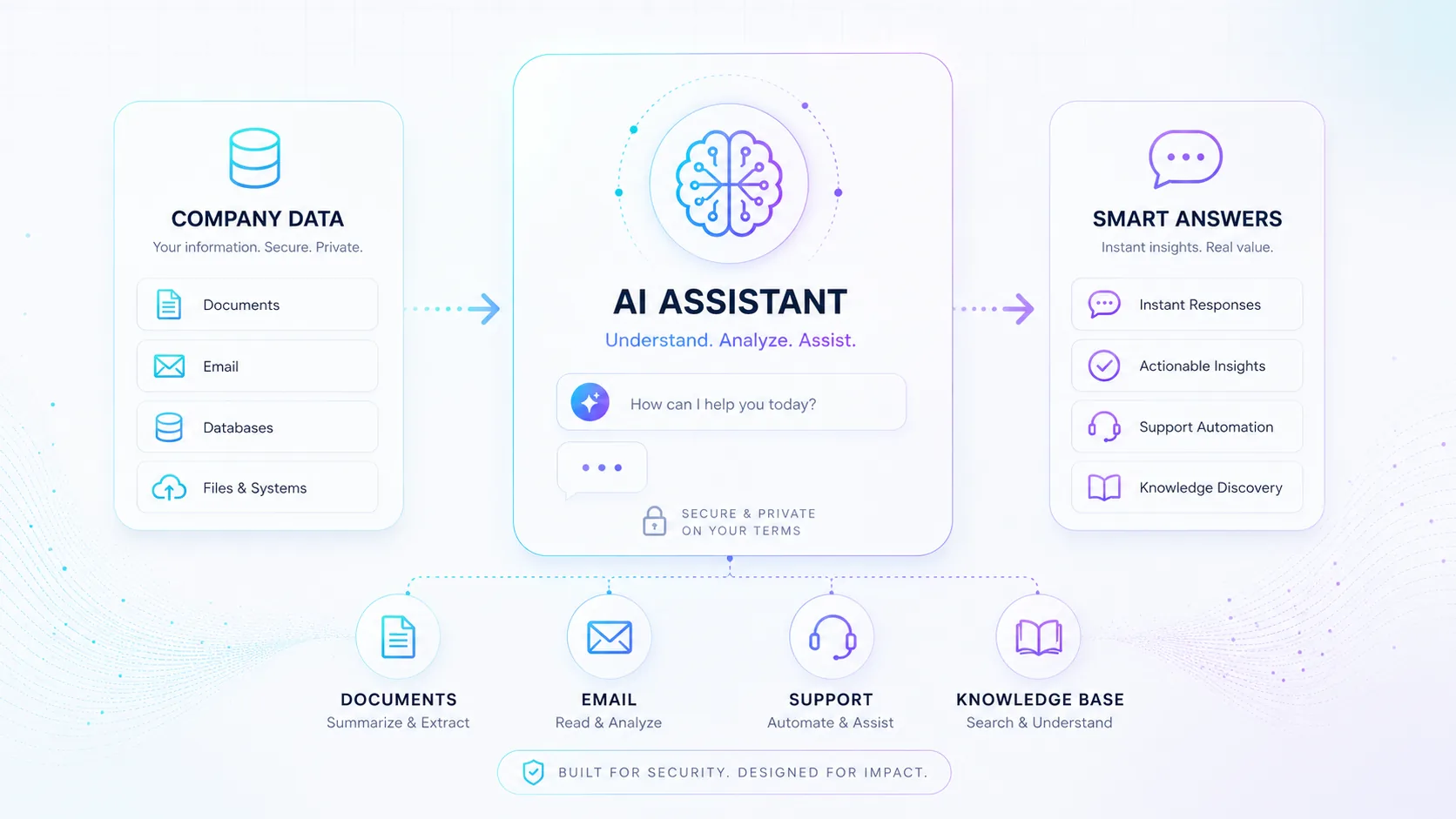
What we help you with
We help companies use AI in a practical and secure way. It can be about summarizing documents, creating internal assistants, building support for customer service or automating recurring tasks. If sensitive material is involved, the solution can be adapted with higher requirements for access, storage and deployment.
When this service fits
A good fit if you want to try AI in a concrete way: summarize documents, answer common questions or automate recurring work.
What can be included
- AI workshop to find the right use cases
- Chatbots and internal AI assistants (RAG)
- AI for documents, email and support
- Secure deployment, monitoring and improvement
Packages & starting prices
Starting prices give a clear baseline for different types of work. Smaller jobs can often start quickly, while larger projects begin with a short review or pre-study. After the review you get a clear proposal with scope, price and next step.
| Package | Best for | Starting Price |
|---|---|---|
| AI review | Identify use cases, risks, data needs and priorities | from $290 |
| AI Opportunity Workshop | Workshop to find the right AI cases and next steps | from $490 |
| FAQ Chatbot | Simple chatbot for common questions and lead capture | from $499 |
| AI prototype | Small prototype to test an AI case | Custom quote |
| Personal AI Assistant | Role-specific assistant for sales, support or administration | Custom quote |
| AI Document Analysis | Summarize, classify and extract data from documents | Custom quote |
| Internal AI Assistant / RAG | Search internal documents, policies, routines and knowledge bases | Custom quote |
| Secure AI Solution | Custom quote after security and needs analysis | Custom quote |
AI API costs, model usage, storage, hosting and third-party platform fees are billed separately when applicable.
All prices are starting prices in USD. Hosting, domains, licenses, third-party tools, advertising budget, AI usage and external platform fees are not included unless stated in the proposal. Final pricing depends on scope, integrations, content and support level.
Frequently asked questions
AI solutions are about using AI practically in the business to save time, structure information and support recurring tasks. This can include a chatbot, an internal AI assistant, document analysis, email support, quote suggestions or automation of administrative workflows.
The goal is not to use AI for its own sake, but to find clear use cases where the technology creates real value.
AI is suitable when you handle a lot of text, many questions, recurring documents, customer cases, internal routines or information that takes time to search through. It can also be useful when staff often write similar replies, summarize material or need decision support.
If the work is clearly rule-based, regular automation may be enough. If the work requires interpretation, summarization or sorting, AI may be more relevant.
A good first step is to identify a concrete use case. This can be done through an AI workshop where we review your processes, data, risks, opportunities and priorities.
After the workshop, it becomes clearer which AI solutions are worth building first and which should wait.
An AI workshop can include a review of the company’s workflows, recurring manual work, data sources, security requirements, risks and possible AI use cases. The goal is to find practical use cases that can create real time savings or better quality.
After the workshop, you can receive a prioritized list of suggestions, estimated complexity and recommended next steps.
An AI chatbot FAQ is a simpler chatbot that can answer common questions, guide visitors and collect leads. It is suitable for a website where many visitors ask similar questions about services, pricing, booking or contact.
This type of chatbot is often a good first step for companies that want to test AI without building a large system immediately.
An AI chatbot can answer common questions, explain services, guide visitors to the right page, collect contact details or forward cases to the right person. It can also help qualify leads by asking follow-up questions.
For more advanced needs, the chatbot can be connected to customer data, CRM, ticketing systems or internal documents.
A simple AI chatbot is often based on common questions and simpler information sources. A custom AI chatbot can include more advanced logic, customer data, integrations, logs, fallback, ticket handling and clearer control over what it is allowed to answer.
A custom solution is better suited when the chatbot becomes an important part of customer service, lead generation or internal support.
Fallback means what the chatbot does when it does not know the answer or when the question requires human handling. This may include asking for contact details, creating a ticket, referring to support or clearly stating that the question needs to be reviewed by a person.
Good fallback is important so the chatbot does not provide incorrect or uncertain answers.
A personal AI assistant is a role-specific assistant that helps a certain type of user, such as sales, support, administration or management. It can help with drafts, summaries, prioritization, follow-ups, documents and recurring tasks.
The assistant is adapted to the role and the work it should support.
AI can help sales teams summarize customer conversations, create follow-up email drafts, prioritize leads, structure notes, suggest next steps and create simpler quote material.
This allows salespeople to spend more time on customer contact and less time on administration.
AI can help customer service by summarizing cases, suggesting replies, sorting incoming questions, prioritizing urgent cases and finding information in internal routines or previous solutions.
AI should be used as support where quality and speed matter, while important replies should still be possible for staff to review.
AI can help administration and management with summaries, report drafts, document review, meeting material, prioritization, decision support and follow-up of recurring work.
This can be especially valuable when information is spread across documents, email, spreadsheets or different systems.
AI for document analysis means using AI to summarize, classify or extract information from documents. This may apply to contracts, reports, meeting notes, quotes, email threads, cases or other text-based material.
The solution can help staff quickly find important points, risks, dates, parties, amounts or actions.
Yes. AI can summarize long documents, email threads or reports and highlight important points. This can save a lot of time, especially when the material is extensive or several people need a quick overview.
For sensitive material, hosting, access and data storage need to be planned more carefully.
Yes. AI can be used to extract information such as names, dates, amounts, terms, deviations, categories or other fields from documents. This can then be used in reports, systems, CRM or internal workflows.
The result should be quality checked, especially if the information is used for decisions, contracts or finance.
An internal AI assistant with RAG can search the company’s own documents, routines, contracts, policies or knowledge base and provide answers based on that material. RAG stands for Retrieval-Augmented Generation and means that the AI retrieves relevant information before generating an answer.
It suits companies that want to make internal knowledge easier to find and use.
An internal AI assistant can help with questions about routines, policies, contracts, technical documentation, onboarding, support material, product information or internal processes. It can reduce the time staff spend searching for information.
It can also be used to provide more consistent internal answers.
It depends on the solution. In many setups, the documents are used as a searchable knowledge source without retraining the model on the material. For sensitive information, it is important to choose a setup where data handling, access and storage are clearly controlled.
We can help choose the right setup based on what information will be processed.
Yes, but it requires a more controlled setup. If the solution will process sensitive documents, customer data, internal contracts or confidential material, higher requirements are needed for access, logging, storage, hosting environment and which external services are used.
When needed, we can build solutions with more restricted or secure hosting.
A secure AI solution can include a custom hosting environment, restricted access, clear roles, logging, controlled data storage, secure document handling and higher requirements for how information is sent or processed.
The exact solution depends on the type of material being handled and the security requirements of the business.
Yes, when needed, AI solutions can be reviewed or built with local or more controlled hosting. This may be relevant when material should not be sent to open external AI services.
A local or more restricted solution usually requires more planning, technology and budget than a simpler cloud-based AI solution.
Yes. AI can often be connected to systems such as CRM, ticketing systems, document management, email, intranet, databases, spreadsheets or customer portals. This allows the AI solution to become part of a workflow instead of a separate tool.
First, we need to review the systems’ APIs, access and what data should be used.
Yes. AI can help create draft quote suggestions based on the customer’s needs, previous material, templates, service packages and internal guidelines. This can save time and create more consistent material.
Final quotes should always be reviewed by a person before being sent to the customer.
Yes. AI can help summarize email threads, suggest replies, sort incoming emails, create drafts or prioritize messages. This can be useful for support, sales, administration and management.
For email automation, it is important to control what the AI is allowed to read, write and send automatically.
AI should mainly be used as support, not as the sole decision-maker in important matters. It can summarize, suggest, prioritize and provide material, but humans should review results that affect customers, finance, legal matters, security or staff.
This is especially important in workflows involving sensitive information or high business risk.
We build solutions with clear limitations, instructions, fallback, testing and follow-up. For internal assistants, answers can be connected to source material so the user can more easily check where the information comes from.
AI can still make mistakes, so the solution should be adapted to how critical the answers are.
Yes. AI solutions should be tested with real examples before being used in live workflows. Testing shows whether the AI understands the right type of questions, uses the right information, gives reasonable answers and handles uncertainty safely.
For solutions that handle customer contact or sensitive information, testing is especially important.
After launch, the solution may need monitoring, improvement and updates. This can include adjusting instructions, improving knowledge sources, reviewing logs, adding documents or changing integrations.
AI solutions work best when they are maintained and improved over time.
Yes. Documents, routines, systems and workflows change. If the AI is based on old information, the answers can become incorrect or less relevant. Therefore, knowledge sources, integrations and instructions should be kept up to date.
For business-critical solutions, ongoing maintenance is recommended.
It depends on the scope. A simpler FAQ chatbot can often be built faster, while internal AI assistants, document analysis, integrations and secure AI solutions require more planning, testing and technical setup.
After a review or workshop, we can provide a clearer timeline.
The price depends on scope, data sources, integrations, security requirements, hosting environment, testing and how much customization is needed. A simpler FAQ chatbot has a lower starting price, while RAG solutions, document analysis and secure solutions for sensitive material require more work.
External costs such as licenses, API usage, hosting or operation may be added where relevant.
If you want to test AI in a simple way, AI Chatbot FAQ may be a good start. If you do not know which use case is best, an AI Workshop is suitable. If a specific role needs support, a Personal AI Assistant may be right. If you want to use customer data, integrations or logs, a custom AI chatbot is often needed.
For internal documents, an Internal AI Assistant / RAG is suitable, and for sensitive material, you should choose a secure AI solution with higher requirements for hosting and access.
We need to understand which problem you want to solve, which users will use the solution, what information the AI should access, which systems are used today and whether there is sensitive material or special security requirements.
Examples of documents, email flows, customer questions, routines or manual tasks are often very useful in the beginning.
Want to know what it would cost for you?
Book a free meeting and we'll do a short needs review and come back with a clear proposal.